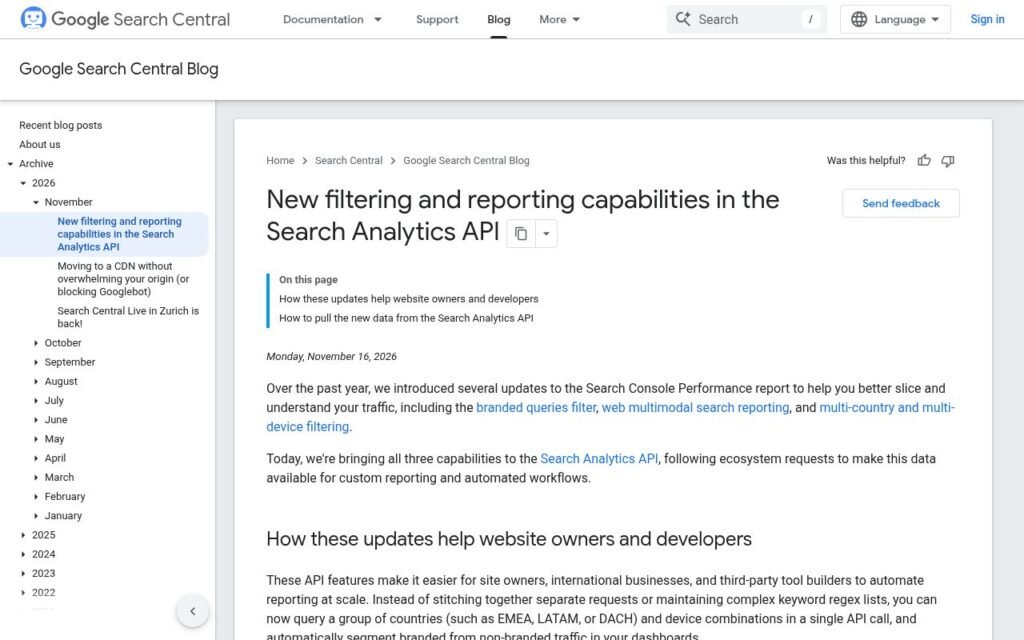
On November 16, 2026, Google’s Search Console team shipped three long-awaited additions to the Search Analytics API: branded query filtering, web multimodal performance data, and the ability to filter by multiple countries or devices in a single request. All three already existed inside the Search Console web interface. Now they are available programmatically, which changes what you can automate and how clearly you can see your brand’s footprint in search.
What Google actually shipped
Google’s Daniel Waisberg, Nati Yosephian, and Karin Gadasi announced the update on the Search Central blog, framing it as a direct response to developer and agency requests for custom reporting and automated workflows. The three additions are:
- Branded queries filter: A new
brandedClassificationdimension lets you group or filter results byBRANDEDorNON_BRANDED. This tells you, at a glance, how much of your search traffic is people already looking for you versus people discovering you cold. - Web multimodal type: Setting
typetowebMultimodalreturns performance data from Google Lens, Circle to Search on Android, and image uploads in Google Search. This data will also be available in BigQuery for properties with an active bulk data export. - Multi-country and multi-device filters: A new
filterListsfield lets you query regional groupings like EMEA, LATAM, or DACH alongside device combinations in one API call, instead of stitching together separate requests.
A few details worth knowing before you build anything
The branded classification data only goes back to February 21, 2026. According to Search Engine Journal’s coverage of the announcement, a Search Console user asked Google’s John Mueller whether older data could be retroactively split into branded and non-branded categories. Mueller confirmed there is simply a point when the tracking starts, so do not expect historical segmentation before that date.
The brandedClassification dimension is also restricted to top-level properties. If your property does not meet Google’s minimum query and impression thresholds, the API response will come back empty. That is not a bug. It is an eligibility gate, and it matches how the feature behaves in the web UI.
Search Engine Journal also notes that as of November 16, the BigQuery bulk export table does not yet list a multimodal value, even though Google’s post says multimodal data will be available there. No date was given for when that lands. Worth keeping an eye on if you run a bulk export pipeline.
Why this matters for business owners, not just developers
Most site owners look at total clicks and impressions and call it a day. The problem is that branded traffic and non-branded traffic tell completely different stories. Branded clicks mean people already know you exist. Non-branded clicks mean you are reaching new audiences. Mixing them together in a single metric makes it almost impossible to judge whether your SEO is actually growing your reach or whether you are just riding your existing reputation.
Now that the Google Search Console API branded queries filter new features are available programmatically, any reporting tool, dashboard, or automated workflow you use can surface this split automatically. For international businesses, the multi-country filter is similarly significant: instead of pulling separate reports for each region and manually combining them, you can query your EMEA or LATAM footprint in a single call.
Multimodal is the newer story. If a meaningful share of your audience is finding your products through Google Lens or Circle to Search, that traffic has been invisible to API-based reporting until now. Visual search is not a niche use case anymore, particularly for ecommerce and lifestyle brands.
How to put this to use on your own site
You do not need to touch any WordPress settings for these changes. This is an API update, not a plugin or theme change. What you do need is access to the Search Analytics API, either through Google Search Console’s own interface (the filters were already there) or through a tool that queries the API directly.
A few practical starting points:
- Log into Search Console and confirm your property is verified at the top-level domain, not just a subdomain, since branded classification requires a top-level property.
- Check whether your property shows branded data already: open the Performance report, look for the branded queries filter, and see if you get rows or an empty state.
- If you use a third-party SEO or analytics platform, ask your provider when they plan to add
brandedClassificationandwebMultimodalsupport. The API documentation is live, so there is no technical barrier on their end. - If you run a BigQuery bulk export, watch for the multimodal search type to appear in the table schema. No release date has been confirmed yet.
Where this fits into ongoing SEO work
Pulling branded versus non-branded splits is exactly the kind of insight that shapes a sensible SEO strategy. If your branded share is growing but non-branded is flat, you are probably not reaching new audiences, and content or link work is likely overdue. If non-branded is climbing, something in your strategy is working and deserves more investment.
This kind of regular read of your data is what we do as part of our SEO and technical audits. And if you want someone watching these signals month over month rather than waiting for a quarterly check-in, our care and maintenance plans include performance monitoring so changes like this feed into real decisions about your site.
If you want to talk through what branded query data is showing for your property or how to get multimodal reporting into your dashboard, book a free 30-minute call and we can take a look together.